The history of finance can be viewed as an entire thread weaving its way through all of human civilization, intertwined with trade, innovation, and the development and decline of societies. Over time, as humanity’s reliance on this all-powerful system expanded, finance morphed from barter systems into today’s incredibly complex web of electronic transactions and artificial intelligence. Tracing the timeline of finance’s long, fascinating history is helpful for understanding its present, and projecting into its future.
Here’s a tour of the history of money.
The Dawn of Finance
Long before any bank even existed, the communities of mankind had a basic understanding of some financial concepts. The concept of exchanging money for a product or a service that a customer has may even predate that of money, since such goods and services may be bartered for money that represents their value.
Barter systems came first: before money was ever dreamed up by mankind, a product or service that a community needed was simply exchanged for a different product or service they no longer needed. Money in its simplest form – the creation of coins or currency – allowed exchange to happen on a more standardized basis. Banks that would hold our money didn’t come into the picture until a much later stage in development.
The Era of Modern Banking
Ancient civilizations started creating banks for deposits, loans, and even interest. Written financial records improved greatly. The creation of central banking was vital for national economies and stability, while the stock exchange was developed so that large companies could more easily raise capital by selling stock shares to investors. Financial management expanded into more abstract concepts, including insurance and risk assessment, and international finance began to dominate.
In today’s environment, it is the role of digital banking technologies, smart contracts, artificial intelligence and virtual reality to define what we perceive as our modern financial system and, of course, how money will change over the course of the next few centuries.
The Digital Revolution in Finance
The digital revolution entirely upended finance as a practice and as an industry.
Online banking: with the internet, banking no longer required the person’s physical presence at the bank. Online money transfers saved us time and effort, while mobile applications made checking bank balances easy.
Online payments: many consumers already carry digital payment systems in their pockets, from Apple and Android Pay to other forms of mobile wallet solutions, including the possibility of transacting within applications.
Automated investment services from robo-advisors and AI-powered platforms to algorithmic trading strategies are making investments more accessible.
Financial data analytics and big data: using algorithms and machine learning to conduct deep and thorough financial analysis.
Today’s Finance Environment
Our modern economy is a mix of legacy financial operations and bleeding-edge technology innovations. The use of fintech – which leverages innovative financial technology – is rapidly becoming a mainstream approach.

The emergence of the cryptocurrency and blockchain movement is challenging traditional models for financial security, digital transfers and monetary control. Increased financial inclusion has helped communities and individuals who previously lacked access to banks or credit, including individuals and developing nations, to engage with the broader economy. The ever-expanding financial sector constantly grapples with adapting laws and regulations to keep pace with its technological growth.
Emerging Trends The Future of Finance
As we gaze into the crystal ball for the future of financial management, here are several key trends to observe.
AI integration: banks and fintech companies are already investing heavily in using AI for a wide array of applications including fraud detection, predictive analytics and risk management, personalized financial advice, customer service chatbots and more.
Decentralized finance (DeFi): the movement to build open-source financial infrastructure on blockchains and the concept of decentralized finance seeks to eliminate traditional financial institutions as intermediaries.
Sustainable finance: this trend involves integrating environmental, social, and governance (ESG) criteria into financial decisions, with a focus on promoting environmentally conscious and socially responsible investments and business practices.
CBDCs: some countries are actively exploring the issuance of their own digital currencies – called central bank digital currencies (CBDCs) – which could fundamentally alter how money functions on a national level.
The Challenges of Future Finance
While many positive trends await us, the future of finance will also bring considerable challenges. Cybersecurity will undoubtedly continue to be a top priority as the global financial system becomes increasingly digital. Adapting regulation will be critical to maintain a stable, efficient, and secure financial market as technology continues to rapidly evolve. Although financial inclusion has increased, many remain excluded from modern financial systems. Market volatility remains a perennial challenge that technological innovation could, in some instances, exacerbate.
Looking Ahead
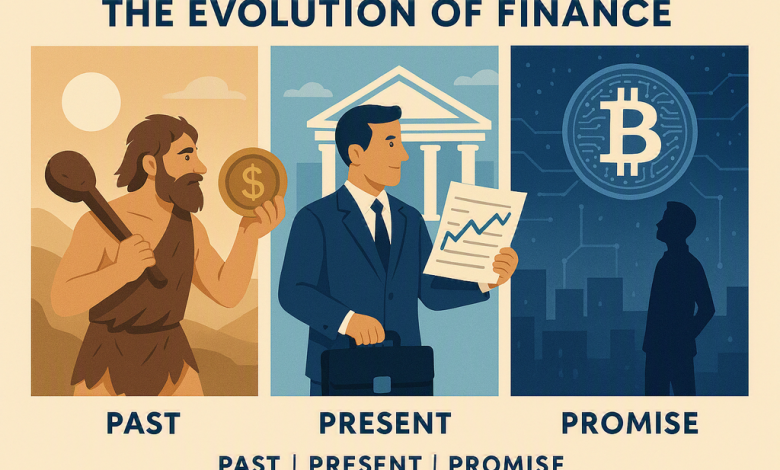
In short, the evolution of finance parallels the development of human civilization in our ongoing efforts to effectively manage value more inclusively and securely. From early, primitive trades to highly sophisticated technological systems of today, each stage of this evolution has leveraged innovation to build on what came before. The continuing wave of change at the intersection of finance and technology guarantees the future of finance will be just as revolutionary,

just as disruptive, and potentially just as transformative, as the history of money itself.
Thanks